

Fodor’s Says “Don’t Visit the Jungfrau Region”. I Say… Absolutely Go.
Whenever I am in the Jungfrau Region, I see the same pattern more often than not. Someone rides up a gondola, steps out, takes a handful of quick photos, mutters about the cost of Switzerland and rides straight back down again. The whole experience lasts less than the time it takes me to unwrap a Müesli bar. No exploring. No wandering. No idea where they actually are.
So when Fodor’s added the Jungfrau Region to its No Travel List 2026, I was not shocked. Not because the region deserves it, but because so many people only ever experience the busiest five‑minute version of it.
But the real Jungfrau Region, the one that appears the second you wander even slightly away from the cable‑car station, is still one of the most breathtaking places on earth.
Let me tell you what the list missed.

Why the Jungfrau Region Is Not Buckling. It Is Brilliant.
One of the things I wish travellers could see is how extraordinarily well this region functions. I have stood at stations and watched staff pivot from a broken train to six perfectly timed buses in less time than it takes most people to choose between a croissant or a pretzel. No panic. No chaos. Just a system doing its job so well that most visitors never even realise something went wrong.
In 2024, when storms ripped through the valley and took out both a road and a railway line, everything reopened within forty-eight hours. Even so, travellers still made it out of Grindelwald by being rerouted over Mannlichen or Kleine Scheidegg like it was the most normal thing in the world.
It was the same story when the Brienz station washed away. The replacement buses connected to the Meiringen trains so smoothly that many travellers assumed this was the standard route. Anyone who struggled usually hadn’t looked at the very large, very clear signs.
This is not a region collapsing under pressure. In fact, it is quietly performing miracles every single day.
Meanwhile, other beautiful areas of Switzerland feel the strain far more intensely despite their best efforts. Crowds are real, but they are not spread evenly.

The Crowds Are Not Everywhere.
They Are Simply Gathered in the Same Few Spots.
The mistake many visitors make is assuming the whole valley looks like the cable‑car platform they just stepped off. It doesn’t. Cable‑car stations act like magnets. They pull people into tight clusters and keep them there because most travellers instinctively stay where everyone else is standing.
But the mountains themselves are enormous. And once you walk even a few minutes, everything changes. The noise drops. The air softens. The crowd disappears. Suddenly you have Switzerland mostly to yourself.
Take the Panorama Trail between Mannlichen and Kleine Scheidegg. It is beautiful, easy and incredibly popular, which is exactly why it goes viral. But it is just one trail. There are countless others that offer the same grandeur with far more breathing room. The Romantic Trail to Alpiglen. The Bussalp to Bort walk, which feels like a whispered secret from the valley. Quiet forest paths where cows outnumber people twenty to one.
The crowds are not hiding Switzerland. They are simply blocking the most obvious doorway.
Travel has, for many people, become more of a flex they can share on social media than the kind of travel I consider meaningful, the kind rooted in curiosity, observing how other people live and learning something along the way.
Influencers Are Sending Everyone to the Same Photo Spots
Most travellers today are not exploring the Jungfrau Region in any real sense. They are trying to recreate a photograph they saw online. Instead of unfolding a map or asking a local for a recommendation, they head straight for a viewpoint they saw in a reel and treat that single patch of ground as if it represents the entire region.
No curiosity. No meandering. No detours just because a trail looks inviting.
It is not malicious; it is simply how travel has shifted. Social media funnels millions of eager visitors into the same tiny handful of locations, and everyone is shocked when those places feel crowded.
The mountains themselves are as spacious and majestic as they have ever been. People are just all being directed to the same twenty square metres.

And Then Came Crash Landing on You
We also cannot ignore the impact of that little global phenomenon known as Crash Landing on You. The show is gorgeous, the filming locations are unforgettable and the tourism response has been enthusiastic to say the least.
The small pier on the edge of Lake Brienz is the clearest example. It is tiny. It was once a quiet spot where locals went for peaceful evening walks. Now people fly across the world to stand on that one slice of wood and recreate a beloved scene. Lovely for fans, not so lovely for a structure never designed for that kind of spotlight.
The region itself did nothing wrong. It simply hosted a hit series and is now navigating the afterglow.

The Real Strain Comes From Day Trippers
Here is something people rarely say plainly. Not all visitors create pressure. Overnighters usually don’t. The real strain often comes from day trippers who drive into the valley, creep down the road at ten kilometres an hour, stop in traffic to take photos, spend almost nothing locally, and leave again before they have even had time to form an impression.
This rushed style of travel gives no one a meaningful experience. Not the traveller. Not the valley. Not the local businesses built on hospitality.
Switzerland is at its best when travellers slow down, stay a while and let the rhythm of the place sink in. And for the record, I happily spend my own money in this region year after year because these mountains give me far more than I could ever return.
If a day‑visitor tax would help protect the valley, I would gladly pay it.

Airbnb Is Not the Problem. Hotel Layouts Are.
There is also noise around travellers choosing Airbnb accommodation, but this frustration is often misdirected. Families are not avoiding hotels out of spite. They are avoiding them because most hotel rooms in the region start around 350 francs and many only sleep three people.
My clients are often families of four or five. Booking two hotel rooms every single night is simply not feasible.
Airbnb solves a very practical problem: families want to stay together without doubling their accommodation budget.
Hotels in the region are facing enormous financial pressures. Many are up for sale because of the challenging business model. But blaming Airbnb misses the wider issue. Families need rooms designed for families.
This issue is not unique to the Jungfrau Region. Airbnb has stepped in to offer a type of accommodation that hotels have not prioritised, and the result is that it reduces long term rental stock for workers. That absolutely makes life harder for the people who live here. But until hotels reconsider their room layouts and price models so families can realistically stay with them, travellers will continue choosing the option that allows them to stay together without blowing their budget.

Your Itinerary Might Need More Imagination
Almost every traveller arrives with the classic trio of Lucerne, the Jungfrau Region and Zermatt. Beautiful choices of course, but also the busiest.
Switzerland opens up in extraordinary ways if you colour a little outside the lines. Appenzell with its rolling hills and painted houses. The Engadine with its quiet, wide valleys. The relaxed cluster of Gstaad, Gruyeres and Montreux that feels like an entirely different story.
And here is something almost no one talks about. Booking outside of peak season is wildly underrated. September and October are arguably the most beautiful months in Switzerland. Even Roger Federer says so. Come in autumn and you will have crisp air, golden light and the kind of peaceful trails most people think no longer exist. Travel off season and you will almost have the place to yourself.
The Alps are not crowded. Many itineraries simply lack imagination.

Why You Should Not Listen to Fodor’s
Lists like the No Travel List are written from a distance. They are not written by someone who has stood alone on a ridge at sunrise, or watched the valley reset itself after a storm, or wandered through a meadow with nothing but cows and clouds for company.
Lists chase attention. Your holiday should chase joy.
Please do not cancel your dream trip because a headline told you to. If you wander even a little beyond the obvious, the Jungfrau Region will give you something unforgettable.
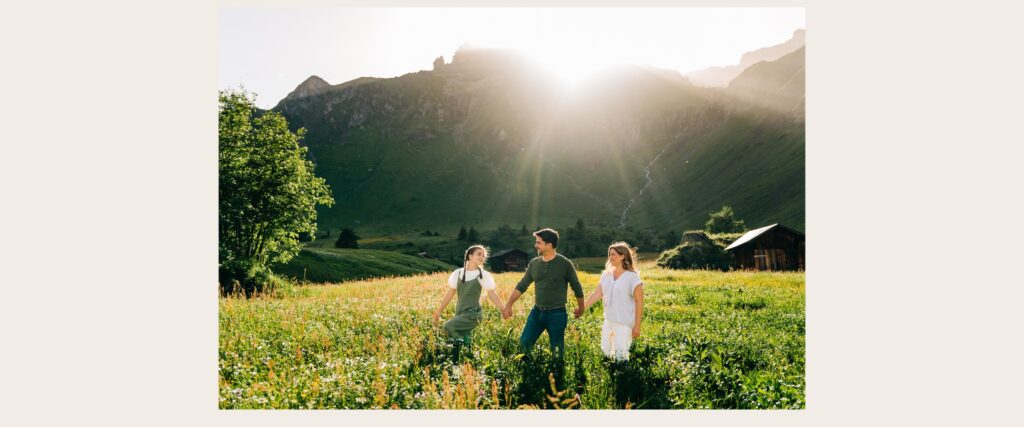
And If You Want the Quietest Corners of the Region…
This is where a photoshoot becomes more than a photoshoot. It slows everything down. It takes you into the parts of the valley most visitors walk straight past. It gives you a chance to breathe, to wander, to feel the place rather than rush through it.
If you want that kind of experience, you are always welcome to book a session with me. I know where the calm lives, where the light lands and where the beauty shows up even on the busiest days.
The Jungfrau Region is not the problem. The way people travel is.
My advice is simple. Absolutely still travel to this magnificent region. Go with curiosity, not urgency. Wander, do not rush. Let the place reveal itself to you. I know I will keep returning for many years to come. I am a card‑carrying member, after all.
And perhaps what makes me so protective of this valley is that my clients are the exact kind of travellers who know how to treasure an experience rather than rush through it. They are perfectly content to sit on an alpine terrace with a cold beer while their children run wild on a nearby playground, pinching themselves that this is their real life for the day. Those are the moments that stay with you. Those are the memories that make the mountains feel like magic.

Frequently Asked Questions
Is the Jungfrau Region still worth visiting in 2026?
Yes. Despite reports of overtourism, the region is incredibly well managed and spacious once you step beyond the busiest viewpoints.
Why did Fodor’s put the Jungfrau Region on the No Travel List?
Because certain viral spots experience heavy traffic, but this does not reflect the experience of the wider region.
How can I avoid crowds in the Jungfrau Region?
Visit early, stay overnight, choose lesser-known trails like Bussalp to Bort or the Romantic Trail to Alpiglen.
Is Switzerland too expensive to visit?
Switzerland has always been expensive, but travellers who research and plan well can make the most of their trip on a budget.